
Bohemian Home Furniture Ideas for Vibrant Interiors
There is a moment — somewhere between the third vintage market and the second impulsive online purchase — when a room stops being a collection of furniture and becomes a world. That is the promise of bohemian interior design: not a style you can replicate from a catalogue, but a living, layered atmosphere that grows around whoever inhabits it. Richly textured, unapologetically colourful, and radically personal, the boho interior has outlasted every trend that tried to retire it. And right now, it feels more relevant than ever.
The Philosophy Behind the Aesthetic
Bohemian design borrows its name from the 19th-century artistic counterculture — the wandering painters, poets, and musicians who filled their studios with objects collected from markets, travels, and chance encounters. That spirit of accumulation-with-intention remains central to the look today. Unlike maximalism for its own sake, authentic boho interiors possess an internal logic: every piece carries meaning, history, or at least a compelling story. The result is chaos that feels curated, abundance that feels earned.
At its core, this aesthetic resists the tyranny of matching sets. A carved Moroccan side table can sit beside a mid-century rattan armchair without the slightest tension. An embroidered Indian throw can drape across a battered leather daybed with perfect harmony. The skill lies not in coordinating but in balancing — weight, warmth, colour temperature, and scale working in concert even when the individual pieces seem to have come from entirely different centuries.
Furniture That Does the Heavy Lifting
The foundation of any bohemian room is furniture with genuine character. Think low-slung sofas and floor seating arrangements that invite lounging over sitting upright; oversized ottomans upholstered in kilim fabric or jewel-toned velvet; beds with carved wooden headboards in walnut, teak, or mango wood. The material vocabulary leans naturally towards the organic and the handmade: woven rattan, turned wood, hammered brass, and hand-thrown ceramics carry an irreplaceable warmth that factory-made pieces simply cannot replicate.
Vintage and antique pieces are the backbone of a convincing boho scheme. A 1970s cane peacock chair, a painted Rajasthani cabinet, a French iron garden bench repurposed indoors — these are not just furniture; they are the focal points around which a room organises itself. If you are working with a tighter budget, resist the temptation to buy new pieces with faux-aged finishes. Instead, haunt estate sales, charity shops, and online vintage markets. Imperfection — a small chip in the lacquer, a slightly uneven patina — is not a flaw; it is evidence of a life lived.
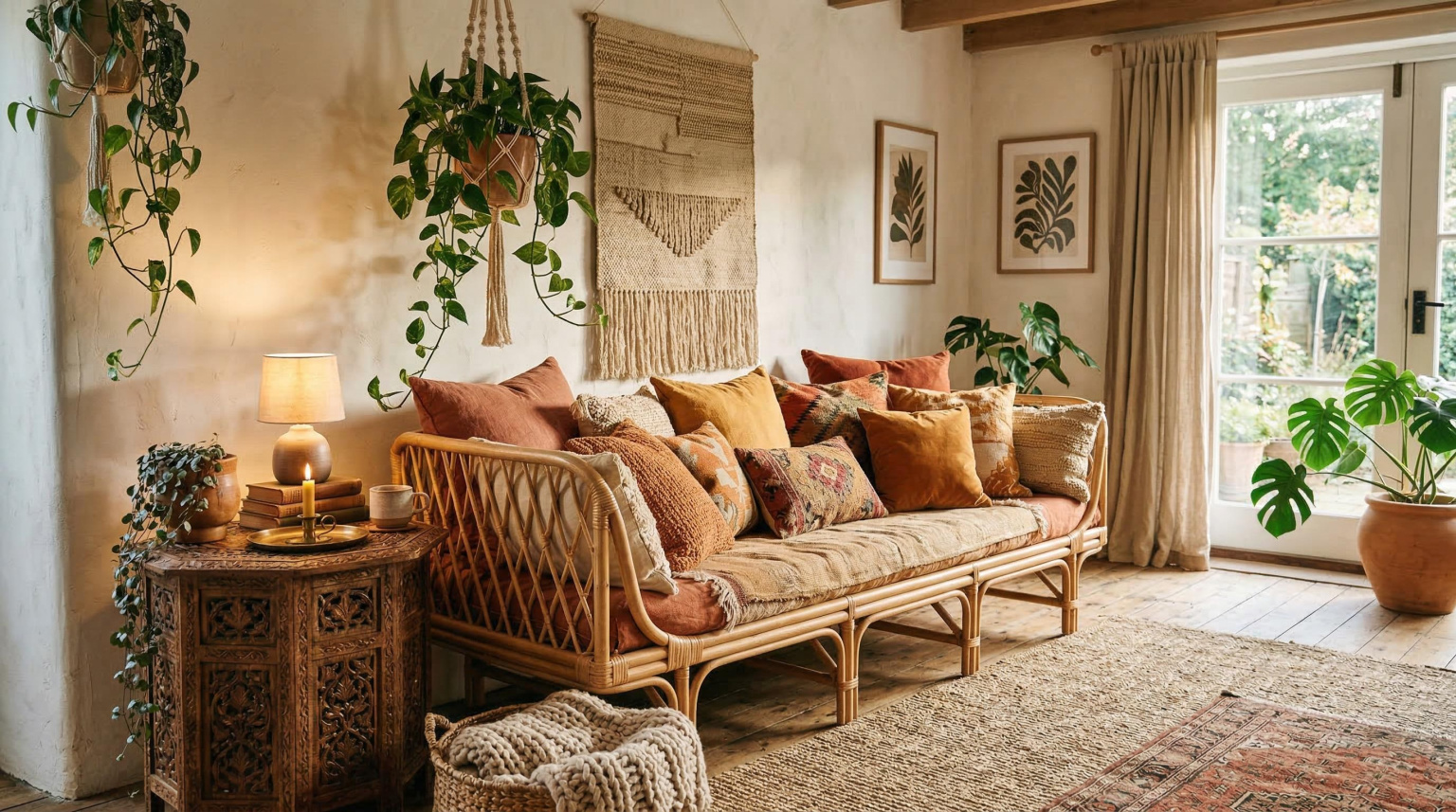
Layering Textiles: Where Boho Truly Lives
If furniture is the skeleton of a bohemian room, textiles are its soul. No other design language uses fabric, weave, and fibre as expressively or as generously. Curtains puddle onto the floor in raw linen or block-printed cotton. Cushions pile onto cushions — embroidered, tasselled, woven, and patchworked. Throws are draped rather than folded, walls are hung with macramé, and beds groan pleasantly under layered quilts and coverlets.
The floor deserves particular attention. A bare floor, however beautiful, is the single fastest way to drain the warmth from an otherwise successful boho scheme. The antidote is a generous, characterful rug — ideally one that is large enough to anchor the entire seating arrangement and interesting enough to hold its own as a visual centrepiece. Hand-knotted bohemian rugs are especially well suited to this purpose: their irregular dye lots, symbolic motifs, and slight asymmetries bring precisely the kind of handmade humanity that mass-produced alternatives cannot fake. In a boho interior, the rug is not an afterthought — it sets the tonal direction for everything placed on and around it.
In larger rooms, the temptation to use a small rug to anchor a single seating cluster should be resisted firmly. Scale matters enormously. A generously proportioned large boho rug unifies disparate furniture groupings into a single composition, making the room feel intentional rather than scattered. Choose something with enough visual complexity — a geometric berber pattern, an abstract tribal motif, an overdyed vintage weave — and let it do the curatorial work of tying together mismatched pieces that might otherwise seem at odds with each other.
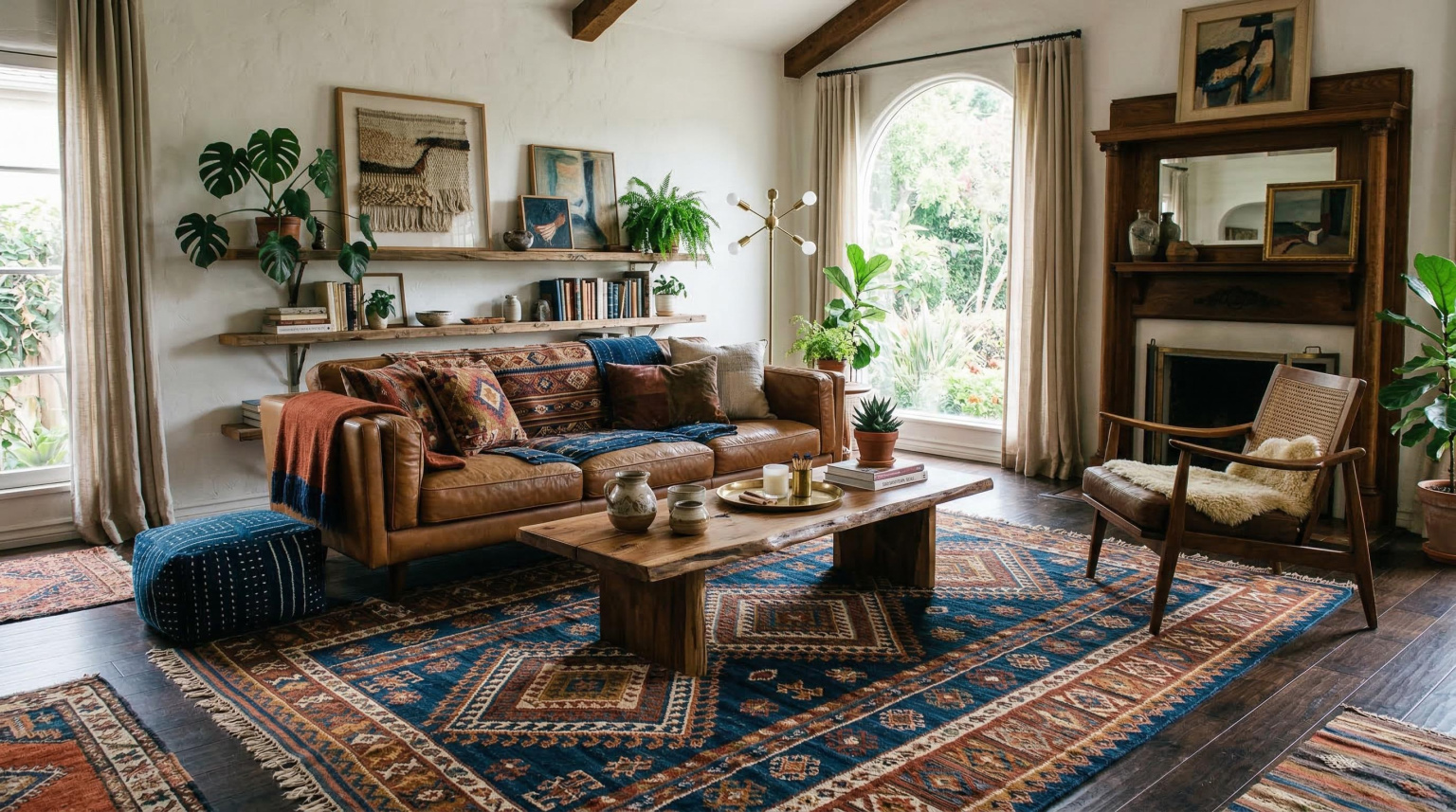
Colour: Brave, Warm, and Unapologetic
Boho interiors have little patience for the cautious neutrals that dominate so many contemporary design trends. The palette is drawn from the warmest end of the spectrum — saffron, terracotta, paprika, forest green, deep indigo, burnt sienna — punctuated by occasional moments of cooler tone to prevent the whole from feeling oppressive. This does not mean that every wall needs to be painted ochre or that restraint has no place. Rather, it means approaching colour with appetite: if you love a shade, use it generously.
Wall treatments in boho interiors often go beyond paint. Limewash finishes add texture and depth with their slightly uneven, matte surface. Wallpapers featuring botanical prints, geometric patterns, or hand-painted motifs can transform a plain room into something lush and immersive. Exposed brick or raw plaster — left unsealed or sealed only to a matte finish — provides an excellent neutral backdrop that absorbs and reflects the warm tones of surrounding textiles and timber without competing with them.
Bringing in the World: Global Influences Done Right
Bohemian interiors have always been a form of imaginative travel. Moroccan lanterns, Indian block-print cushions, Turkish kilims, Japanese indigo textiles, West African woven baskets — the boho aesthetic draws freely from the material cultures of the world, and does so most successfully when it does so thoughtfully. The distinction between genuine cross-cultural appreciation and thoughtless appropriation lies in knowledge and quality. When you invest in a piece that is genuinely handmade by skilled artisans — rather than a mass-produced facsimile — you are participating in a tradition rather than merely borrowing its imagery.
Rug design sits at the very heart of this global conversation. The hand-knotted rug is one of humanity's oldest art forms, produced across Central Asia, the Middle East, and North Africa for millennia. Contemporary designers working in this space — such as Jan Kath, whose work reimagines classical carpet traditions through an adventurous modern lens — demonstrate that the form is very much alive. Kath's designs, which fuse antique Central Asian and Persian motifs with abstract expressionism and contemporary colour, are perhaps the most potent single objects you can introduce into a bohemian interior: they carry the weight of tradition whilst remaining entirely, arrestingly contemporary.
Plants, Light, and the Living Interior
A boho room without plants is a room still under construction. Trailing pothos, monstera deliciosa, fiddle-leaf figs, cacti, and trailing string-of-pearls are all fixtures of the aesthetic — not as decorative props, but as genuine participants in the interior ecosystem. The boho preference for organic materials extends naturally to living ones: plants soften hard edges, add scale variation, and introduce a quality of aliveness that no object, however beautiful, can replicate.
Lighting in bohemian interiors rejects the overhead single-source ceiling light almost categorically. The preferred approach is layered and warm: floor lamps with woven or paper shades casting soft pools of light; clusters of candles in brass or ceramic holders; string lights threaded through bookshelves or draped beneath canopies; Moroccan lanterns punched with star-shaped perforations throwing geometric patterns across the ceiling. The goal is an atmosphere of amber warmth — the interior equivalent of a summer evening that seems reluctant to end.
Personal Tokens: The Details That Make It Yours
What ultimately separates a genuinely bohemian interior from one that has merely borrowed the aesthetic is the presence of the personal. Travel souvenirs arranged on a gallery wall alongside original artworks and vintage prints. A collection of ceramics from a local potter mixed with inherited pieces from a grandparent's kitchen. Books stacked horizontally and vertically because that is how they fit. A musical instrument leaning against the wall, not for display but because it is played regularly.
These details cannot be purchased as a set, which is precisely what makes them irreplaceable. The boho interior is, at its best, a self-portrait — not a stylised one that presents an idealised version of the inhabitant, but an honest one that shows what they collect, what they love, and how they actually live. That is the radical proposition at the heart of the aesthetic: that a home designed around a real person will always be more beautiful, more interesting, and more alive than one designed around a trend.
Where to Begin
If you are starting from scratch, resist the paralysis that can come from trying to assemble the whole picture at once. Begin with one anchor piece — the rug, the sofa, the statement cabinet — and build outward from there, allowing the room to accumulate its character over months and years rather than a single weekend. The best bohemian interiors are never finished; they are always in progress, always absorbing new objects and shedding old ones, always in the process of becoming. That perpetual becoming is not a sign of incompletion. It is the point.