
Crafting Furniture in the Modern Age
There is a particular kind of attention that the finest furniture demands — not the passive admiration of something handsome in a room, but the closer, more considered engagement of someone who has noticed that the joint at the corner of a drawer is not merely flush but precisely, almost imperceptibly, proud of the surrounding surface. That the grain of a walnut tabletop has been matched across its full length with a patience that must have required several discarded planks for every one used. That the leather of an armchair has been pulled and stitched to a tension that will look exactly the same in fifteen years as it does today. These are the details that separate furniture of genuine craft ambition from furniture that has simply been priced as though it were exceptional.
In an era when the mechanisms of mass production have become sophisticated enough to simulate almost every surface quality of handmade work — when a pressed-veneer tabletop can be finished to a smoothness that rivals solid timber, when injection-moulded hardware can approximate the visual weight of cast brass — the ability to recognise authentic craftsmanship has become both more important and more demanding. What follows is an attempt to articulate what that recognition requires.
Why Craftsmanship Resists Definition
The difficulty with craftsmanship as a concept is that it resists the kind of specification that purchasing decisions prefer. A knot count can be measured. A timber species can be verified. But the quality of the hand that applies a finish, the judgement of the joiner who decides how much tension a mortise requires, the patience of the upholsterer who reworks a corner three times before it is right — these are qualities that exist in a dimension that neither specification sheets nor photography can adequately capture.
This is not a romantic observation but a practical one. It explains why the acquisition of genuinely well-made furniture so often requires physical presence — why the showroom visit, the handling, the sitting-in and opening-of-drawers remains irreplaceable as a method of evaluation. The qualities that distinguish exceptional furniture from competent furniture are primarily tactile and temporal: they reveal themselves through touch and through the sustained attention of someone who knows what they are looking for.
What can be said with some precision is that genuine craftsmanship in furniture-making involves three properties in combination: material honesty, constructional integrity, and formal intelligence. The absence of any one of these produces a piece that is, at best, partially successful. Their simultaneous presence produces something that the word craftsmanship only begins to describe.
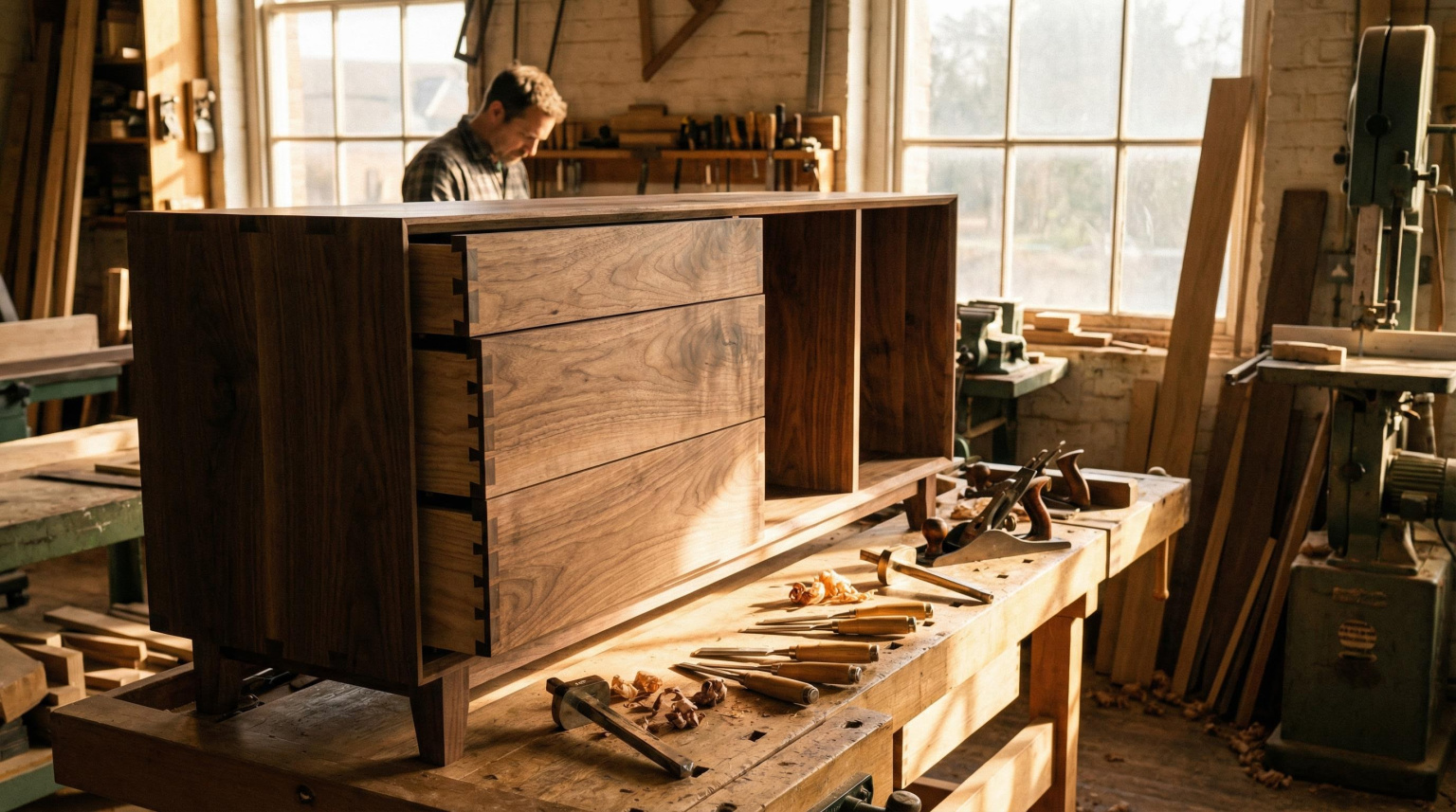
Material Honesty: The Ethics of the Surface
Material honesty is the principle that a piece of furniture should be what it appears to be. Solid timber where solid timber is claimed. Stone that is stone throughout, not a thin skin over engineered substrate. Leather that is leather, not a bonded composite that will peel and delaminate within a decade of use. Brass hardware that is cast, not pressed sheet metal with a yellow coating.
This principle has both aesthetic and ethical dimensions. Aesthetically, honest materials have a visual depth that their simulations cannot match. The figure of a book-matched walnut top, where the grain on either side of the join mirrors the other like an open wing, is a function of the timber's three-dimensional structure — its growth rings, ray cells, and natural variation — and cannot be reproduced photographically or chemically. The patina that develops on cast brass over years of handling is a function of the alloy's composition and the oils and oxidation it accumulates; it cannot be factory-applied and made to look the same. These are not merely aesthetic preferences. They are the visible evidence of a relationship between material and time that gives the finest furniture its particular quality of aliveness.
Ethically, material honesty is a form of respect for the person who is purchasing. The market for premium furniture contains a great deal of work that presents itself, through design, pricing, and marketing language, as something more substantial than it is. The consumer who cannot distinguish solid from veneered, cast from pressed, full-grain from corrected leather is not well served by an industry that has every commercial incentive to obscure these distinctions. The makers who are transparent about their materials and their processes — who welcome scrutiny rather than discouraging it — are reliable on this point for a reason.
Constructional Integrity: The Architecture of the Invisible
The construction of a piece of furniture is, for the most part, invisible in the finished object. Joints are concealed. Structural members are covered. The mechanisms by which a piece holds together and remains stable over decades of use are not generally available for inspection at the point of purchase. This invisibility is precisely what makes constructional integrity so important a criterion, and so easily falsified.
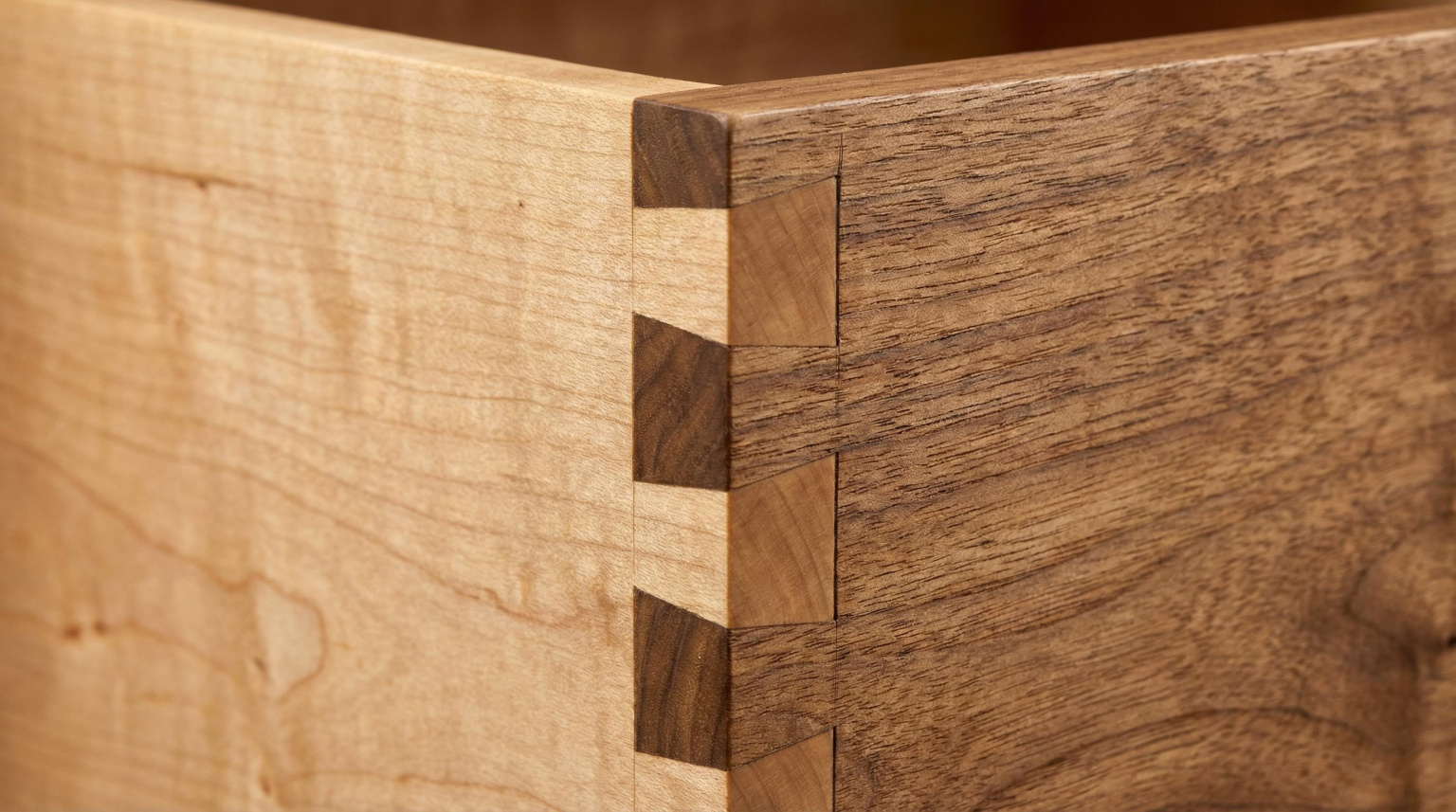
The fundamentals of fine furniture construction have not changed substantially in several centuries. Mortise-and-tenon joints, properly fitted and glued, produce connections of greater strength and longevity than any mechanical fastener. Dovetail joints in drawer construction — those interlocking wedge-shaped fingers that hold the corners of a drawer box without glue alone — are as reliable today as they were in the workshops of 17th-century cabinetmakers. Eight-way hand-tied spring systems in upholstered seating, where each spring is individually tied to its neighbours in both directions, produce a support that distributes weight more evenly and maintains its shape under use far more effectively than the sinuous wire spring alternatives that have largely replaced them in volume production.
These methods are labour-intensive and therefore expensive. They are also, for pieces intended to last decades rather than years, the only rational choice. The economics of fine furniture construction are counterintuitive: the most costly methods of making are also the most economical over any extended time horizon, because they produce pieces that do not need to be replaced. A dining table made with proper joinery and finished with solid timber throughout is not more expensive than a well-priced alternative over a thirty-year period. It is dramatically less expensive — and, unlike its replacement, it will have acquired character rather than merely age.
Formal Intelligence: Design That Has Been Worked
The third component of exceptional craftsmanship is the most difficult to acquire and the most rewarding to encounter: formal intelligence. This is the quality that distinguishes furniture that has been designed — in the full, demanding sense of that word — from furniture that has been styled. It manifests in proportions that feel correct rather than merely plausible, in details that reveal themselves slowly and reward sustained looking, in the relationship between the piece and the space it inhabits that suggests a considered understanding of how the two will exist in dialogue.
Formal intelligence in furniture design is rarely the product of a single inspired decision. It is more often the result of a process of working and reworking — of making a leg slightly longer, refining the radius of a curve, adjusting the height of a stretcher until the visual weight of the piece resolves into something that feels both inevitable and surprising. The finest designers are those who submit their work to this process of refinement without the impatience that would settle for adequacy. The result is pieces whose proportions seem obvious in retrospect but whose achievement is anything but.
Contemporary furniture design is producing work of genuine formal ambition across a range of traditions and aesthetic languages. The commitment to honest materials, precise construction, and resolved design that defines exceptional work is not the exclusive property of any single national tradition or design school. It is found in the joinery workshops of Scandinavia and the upholstery ateliers of northern Italy. It is found in the small-batch studios of British makers working in the tradition of Arts and Crafts, and in the design-led workshops of Japan, where the concept of monozukuri — the art of making things — carries a cultural weight that no translation entirely captures. For those assembling a collection of pieces that meet this standard, the work represented in dedicated luxury furniture collections offers a useful concentration of makers whose practice genuinely reflects these values.
The Contemporary Moment: Craft as a Counter-Position
The renewed interest in exceptional craftsmanship in furniture — and it is genuine, not merely the marketing positioning of the luxury segment — is best understood as a counter-position to the broader direction of consumer manufacturing. In a market where the mechanisms of mass production have become extraordinarily sophisticated, where the gap between the appearance of quality and the reality of it has never been easier to exploit, the demand for furniture that is genuinely what it presents itself as represents something more than aesthetic preference. It is a position about what kind of relationship with objects is worth having.
A piece of furniture made with full seriousness — in which the material, construction, and design each reflect the best available knowledge and the patience to apply it properly — asks to be used rather than merely displayed, to be kept rather than replaced, to become part of the life of a household in the way that significant objects do over time. It accumulates the evidence of use — the slight rounding of a much-handled edge, the deepening of a patina — in a way that adds rather than subtracts from its presence. It is, in the most precise sense, the kind of object that gets better with time.
This is not a nostalgic argument. The finest contemporary furniture-makers are not attempting to replicate the past; they are working with the full range of current materials knowledge, design intelligence, and technical capability to produce pieces that meet the demands of how people actually live now. What they are preserving is not a set of historical techniques but a set of values: that materials should be honest, that construction should be invisible because it is perfect, and that the best design is the kind that continues to reveal itself years after the first encounter. These values are not specific to any era. They are simply what exceptional making looks like, and they always have been.