
The Art of Creating Bespoke Rugs
A rug is rarely just a rug. At its finest, it is a distillation of place, memory, and mastery — woven or tufted over days, weeks, sometimes months by hands that understand tension, texture, and the quiet geometry of pattern. Bespoke rugs occupy a category of their own: not mass-produced, not decorative filler, but considered objects commissioned to meet a singular vision. To understand what makes them extraordinary, you have to follow the thread back to where they begin.
The Commission: Where It All Starts
Every bespoke rug begins with a conversation. A client arrives with a mood, a floor plan, a swatch of upholstery, or nothing more than an instinct about color. The craftsman's first task is translation — converting abstract desire into tangible specification. Pile height, knot density, fiber selection, dye palette: each variable is a decision with aesthetic and functional consequences. This dialogue between maker and client is not incidental to the process. It is the process. Without it, a rug may be handmade, but it will not be bespoke.
What separates a bespoke commission from an off-the-shelf piece is the specificity of intent. Dimensions are calibrated to the exact room. Colors are matched to existing architecture. Motifs may reference family heritage, a landscape, or a geometric vocabulary the client has been quietly developing for years. The result, when executed well, is a floor covering that feels as though it could not exist anywhere else — because, in truth, it couldn't.
Material Decisions: The Foundation of Character
Before a single knot is tied or a tufting gun loaded, the choice of fiber sets the entire register of the finished piece. Wool remains the dominant choice for bespoke work: it takes dye with exceptional fidelity, recovers its pile under foot traffic, and develops a patina over time that synthetic fibers simply cannot replicate. New Zealand and Tibetan highland wools are prized for their long, lustrous staple; Ghazni wool from Afghanistan, coarser and resilient, suits high-wear applications. Silk, used alone or blended with wool, introduces light-reflective surfaces that shift dramatically as the viewing angle changes — an effect that turns a flat pattern into something almost three-dimensional.
Natural dyes — pomegranate rind, madder root, indigo, walnut husk — produce colors with a depth that synthetic alternatives approach but rarely equal. The slight irregularity in natural dyeing, far from being a defect, is precisely what gives hand-dyed yarn its warmth. Under direct light, a naturally dyed crimson contains traces of orange and ochre; it breathes in a way that a chemically standardized color does not.
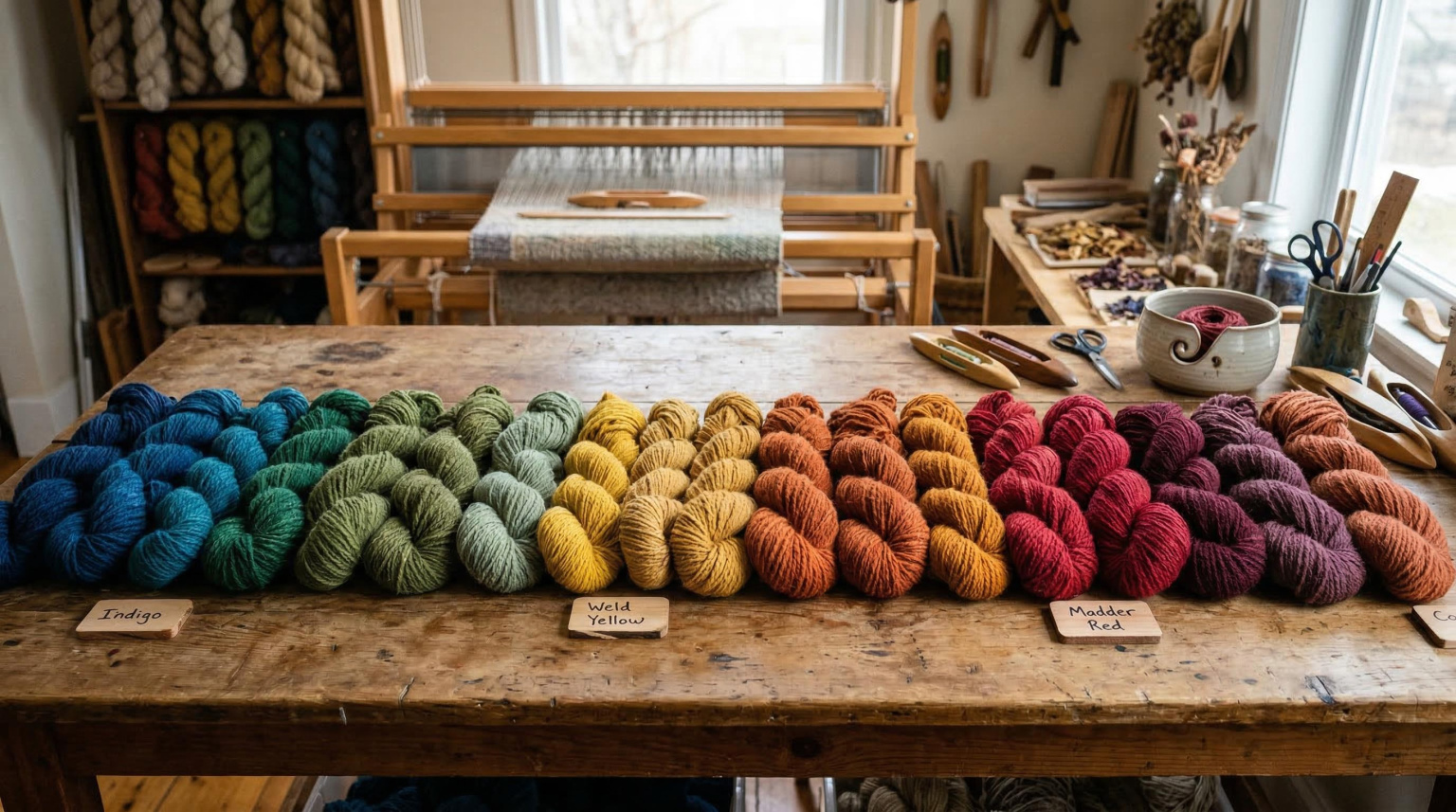
The Three Techniques That Define the Field
Bespoke rug-making is not a monolithic craft. Three dominant construction methods each produce a distinct object — in texture, in density, in longevity, and in visual language.
Hand-Knotted: The Slowest, Most Enduring Form
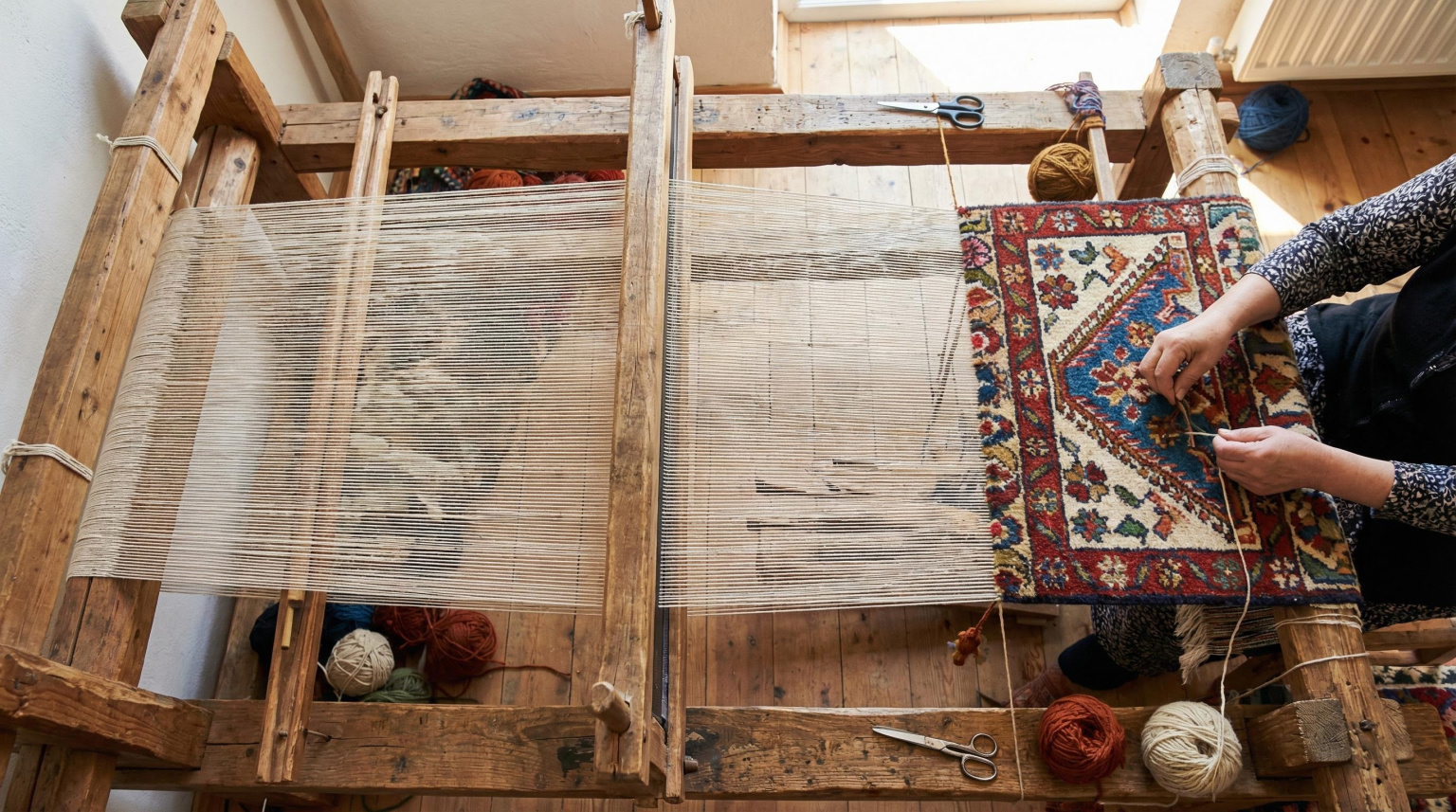
Hand-knotted rugs are built knot by knot, row by row, on a vertical loom. Each tuft of yarn is individually tied to the warp threads — either in the symmetrical Turkish (Ghiordes) knot or the asymmetrical Persian (Senneh) knot — then beaten down and trimmed. Knot density is measured in knots per square inch (KPSI), ranging from as few as 16 in tribal pieces to over 400 in fine Persian and Chinese work. At 400 KPSI, the surface becomes almost porcelain-smooth; the design can hold microscopic detail. A large hand-knotted area rug at this density might require three weavers working in parallel for the better part of a year.
The structural consequence of this method is extraordinary durability. The pile is not glued, stitched, or mechanically inserted — it is literally part of the foundation. Well-maintained hand-knotted rugs are documented to survive centuries. They can be washed, repaired, and re-piled. They are, among textiles, among the most persistent objects human beings make.
Hand-Tufted: Precision at a Different Pace
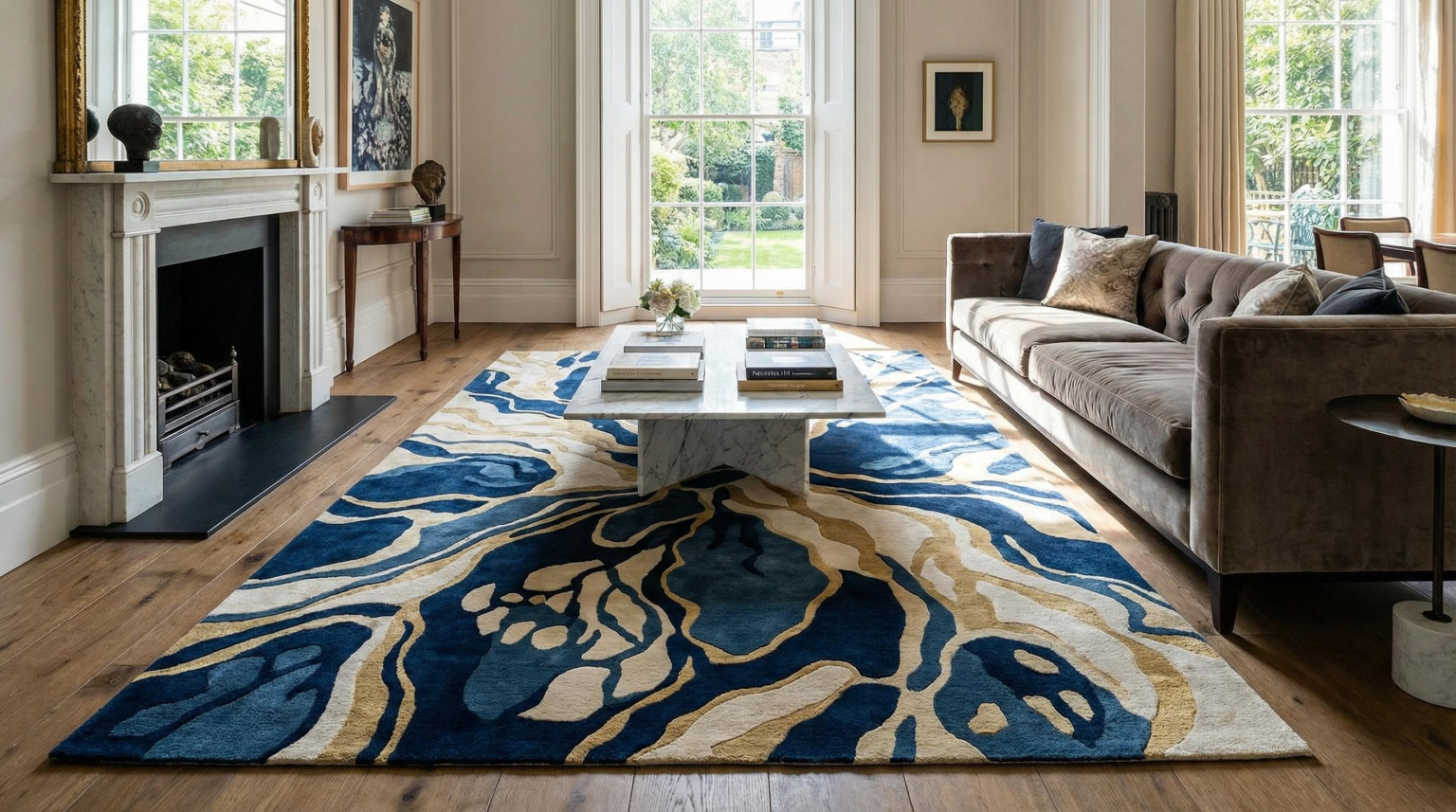
Hand-tufting uses a pneumatic or manual tufting gun to punch loops of yarn through a stretched fabric backing, which are then typically cut to create a cut-pile surface. The process is considerably faster than hand-knotting — a skilled tufter can produce a square meter of dense pile in a fraction of the time — but speed is not the primary motivation for choosing this method. The appeal lies in design flexibility and consistent pile depth, which makes tufting particularly well-suited to bold geometric compositions, painterly abstractions, and large-format work.
Hand-tufted area rugs are finished with a latex backing and secondary fabric, which stabilizes the construction. The result is a piece with a lush, even surface that reads as genuinely handmade — because it is. Each pass of the tufting gun is a manual decision; the outline of every shape is drawn and executed by hand. Pattern complexity is limited only by the designer's draftsmanship, not by the structural constraints of knotting.
Handmade: The Broader Tradition
Beyond these two methods, the category of handmade area rugs encompasses flat-weave techniques (kilim, dhurrie, Soumak), hand-hooked work, needle-felting, and braided constructions. Each carries its own regional genealogy and aesthetic vocabulary. Kilims — woven without pile, the weft threads forming the visible surface — produce crisp, geometric compositions with a graphic authority that pile rugs rarely achieve. Soumak weaving wraps weft yarns around the warp in a herringbone pattern, producing a ridged, slightly sculptural surface. These techniques are not inferior to pile work; they are parallel traditions, with their own hierarchies of skill and their own repertoire of form.
Design Language: Pattern as Grammar
The visual vocabulary of rug design is one of the most sophisticated in decorative art. Medallion compositions — a central motif radiating symmetrically toward a framing border — derive from Persian manuscript illumination and architectural tile work. The Herati pattern, a diamond enclosing a rosette surrounded by lancet leaves, has been in continuous production for at least five centuries. Tribal designs, encoded over generations by weavers who carried patterns in memory rather than on paper, carry their own logic: the slight irregularities, the asymmetric borders, the personal insertions that a weaver might add as signature.
Contemporary bespoke work has expanded this vocabulary considerably. Studio designers now work with rug makers to realize compositions drawn from architectural drawings, digital renderings, or abstract painting. A palette derived from a Rothko canvas. A pattern extrapolated from a structural grid. The craft tradition is capacious enough to accommodate these influences without losing its essential character — because the language of texture, pile, and fiber imposes its own discipline on whatever image is submitted to it.
The Makers: Where Tradition Is Kept Alive
The centers of bespoke rug production — Tabriz, Isfahan, Qom, Kathmandu, Jaipur, Marrakech, Uşak — are not museums. They are working ateliers where the knowledge of centuries is actively practiced and transmitted. In Tabriz, master weavers (ostads) still train apprentices in the asymmetric knot sequences that define the city's tradition. In Nepal, cooperatives of Tibetan refugee weavers produce some of the finest contemporary bespoke work available, combining highland wool with design briefs from international studios. In Morocco, the cooperative structure of medina workshops has proven remarkably adaptable to custom commissions from the global design market.
What these places share is an understanding that speed is not a virtue in this work. A rug made in haste — whether by cutting corners on pile density, using inferior yarn, or skipping the slow process of natural dyeing — reveals itself eventually. The pile compresses unevenly. The colors fade without grace. The backing delaminates. Quality in bespoke rug-making is not an abstraction; it is embedded in time. The hours a weaver spends at the loom are directly inscribed in the object's durability and beauty.
Living With a Bespoke Rug
A commissioned rug is not static décor. It ages alongside the space it occupies. Natural fibers respond to humidity, foot traffic, and light — developing a patina that a new rug cannot simulate. The high-traffic path across a wool kilim will show a slight compression and shine after years of use; this is not damage, it is character accumulated honestly. Proper care — rotation every six to twelve months, periodic professional cleaning, prompt attention to spills — preserves both the structure and this living quality for decades.
The investment logic of bespoke rugs is also distinct from most interior purchases. While a mass-produced rug depreciates immediately, a well-executed hand-knotted commission in quality materials may hold or increase its value over time. Antique rugs from the nineteenth and early twentieth centuries routinely achieve significant results at auction — a testament to the fact that when craft is genuine, the object outlasts the moment of its making and enters a longer history.
Why Bespoke, Why Now
In a market saturated with machine-made approximations of handcraft, the impulse toward bespoke is in part a search for authenticity — for objects whose origin is legible and whose quality is real. But it is also, at its best, something more purposeful: a refusal to settle for a rug that almost fits, almost works, almost expresses what the space requires. The bespoke commission says that a room deserves a floor covering as carefully considered as its walls, its furniture, its light. It says that the floor — the plane every person in the space touches, the ground of the entire composition — is worth the investment of time, skill, and genuine intention.
That intention is what separates a rug from a floor covering. And it is what the best bespoke makers have always understood.